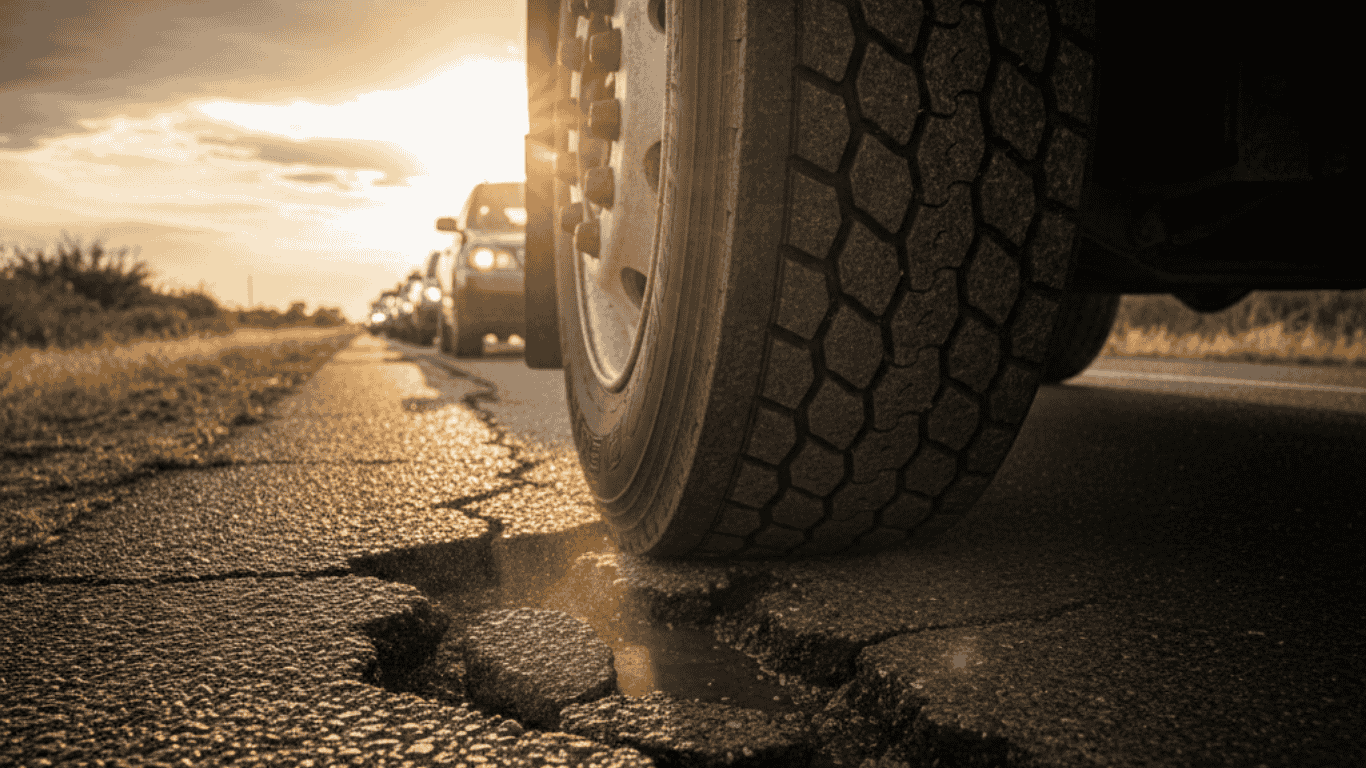
You may think how a single fully loaded tractor-trailer can cause the same amount of road damage as nearly 9,600 passenger cars, right? Well, it is true!
Most drivers assume that road wear is a simple matter of math, like more tires mean more trouble, but the physics of our highways is far more dramatic and punishing. When we look at the asphalt beneath our wheels, we are not just looking at a flat ribbon of stone and oil, but a flexible structure that breathes and bends under every pound of pressure.
Does vehicle weight really affect how long a road lasts?
Every time a tire rolls over a section of pavement, the ground undergoes a tiny amount of strain or deformation. While a standard sedan might flex the pavement slightly, a heavy-duty truck pushes the material to its absolute structural limit. This relationship is nonlinear, meaning doubling a vehicle’s weight does not simply double the damage. Instead, it multiplies the destruction by a huge amount. Engineers call this the Fourth Power Law, which explains why our highways seem to deteriorate even when traffic volume remains the same.
What is the Fourth Power Law in road engineering?
To understand how heavy loads shorten pavement life, we have to look at the math that keeps civil engineers up at night. The Fourth Power Law suggests that the damage caused by a vehicle axle is proportional to the weight on that axle raised to the fourth power. If you increase an axle load from 18,000 pounds to 36,000 pounds, you are not causing twice the damage, but sixteen times the wear and tear. This exponential leap is why a slight overload in cargo can reduce the lifespan of a local street that was never designed for industrial logistics.
The Hidden Costs of Heavy Hauling
| Vehicle Type | Average Weight | Equivalent Car Damage |
| Compact Car | 3,000 lbs | 1 |
| Large SUV | 6,000 lbs | 16 |
| Delivery Van | 12,000 lbs | 256 |
| Loaded Semi-Truck | 80,000 lbs | 9,600+ |
How does weather interact with vehicle weight to destroy roads?
Physics is only half the battle because Mother Nature often acts as an accomplice. When a heavy vehicle travels on a road during a spring thaw or heavy rain, damage is amplified. Water seeps into the sub-base, softening the foundation that supports the asphalt. A heavy truck passing over this squishy foundation creates a pumping action that forces fine particles out of the pavement layers, leading to the dreaded pothole.
Recent data indicate that around 39% of major American roads are in mediocre or poor condition, primarily due to a combination of moisture and increasing freight weights.
Can better tire technology save our pavement?
There is a common myth that adding more tires solves the weight problem entirely. While spreading the load across more axles definitely helps, it is not a magic fix for road longevity. High-pressure tires on heavy trucks actually concentrate the force into a smaller contact patch, which can lead to rutting. Rutting is that annoying groove you feel in the slow lane during a rainstorm, and it is a direct result of the asphalt being literally squeezed out of the way by intense downward pressure.
Why should taxpayers care about axle load limits?
Maintenance is expensive, and the public usually bears the costs. Government reports reveal that the United States currently faces an infrastructure funding gap, with billions of dollars needed to maintain existing bridges and roads. When logistics companies bypass weight stations or overload their trailers, they are effectively borrowing from the road’s lifespan that the rest of us must repay through taxes or vehicle repairs caused by hitting potholes.
Looking Toward a Stronger Future
As we move toward electric semi-trucks, we face a new challenge because battery packs add significant mass to the vehicle. We must balance our desire for green energy with the reality that heavier trucks will require thicker, more expensive pavement designs. Building roads with high-modulus asphalt or reinforced concrete bases can mitigate some of this stress, but the laws of physics remain unchanged.